
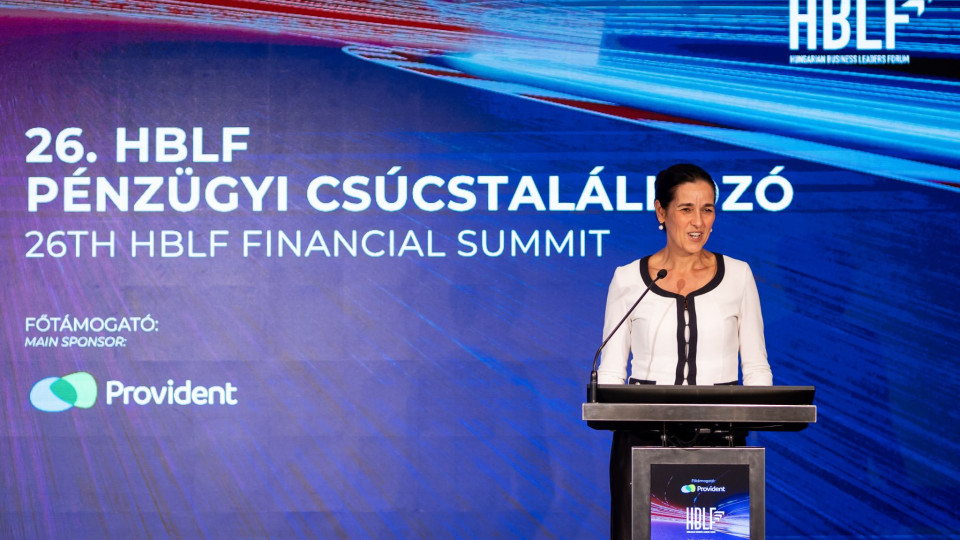
Further utilising the available workforce and making investments alone will no longer provide a sufficient basis for Hungary’s long-term convergence: one of the most important questions for the next period of growth may be how the country can generate greater economic value from the knowledge at its disposal. This emerged at the 26th Hungarian Business Leaders Forum Financial Summit , where economic decision-makers, business leaders and economists examined Hungary’s growth prospects.
Knowledge, competition and trust could form the basis of Hungary’s next period of growth
According to Zoltán Tanács, the aim is to exceed the European average in the long term
In his presentation, Zoltán Tanács, Minister of Science and Technology, pointed out that Hungary currently spends around 1.3 per cent of its GDP on research and development, whilst the EU average stands at around 2.2 per cent; the long-term goal is to reach 3 per cent. According to the Minister, the Hungarian economy must increasingly rely on human capital and sectors generating higher added value, and must ensure that research findings give rise to marketable technologies and internationally competitive enterprises.
It is a misconception that more state support leads to greater productivity
At the same time, it was emphasised at the conference that more investment or more state support does not, in itself, necessarily lead to greater productivity or faster convergence. György Jaksity, Chairman of the Board of Concorde, pointed out that several of the driving forces behind the previous growth model – such as the mobilisation of labour reserves – have now been largely exhausted, whilst the high rate of investment has not always been matched by an adequate return, and the productivity gap between the Hungarian economy and more developed European economies remains significant. In his view, state aid is primarily justified where it results in measurable economic value or the transfer of knowledge or technology. Meanwhile, the discussion, featuring Péter Ákos Bod, Zsigmond Járai, Júlia Király and Péter Oszkó, focused on the issues of financial stability, convergence with the euro and a sustainable economic policy path in the longer term.
“The world is changing at an extraordinary pace today, which is why it is becoming an increasingly important issue for both Hungary and Europe to determine how we can respond to these changes effectively and in a timely manner. As well as boosting labour force participation and stimulating investment, we must also focus on improving efficiency. Knowledge, competitiveness and international cooperation have always been closely linked, but today they perhaps influence one another more strongly than ever before. One of the most important roles of the Financial Summit is to bring together different professional and business perspectives under one roof and to foster a dialogue that can help us think collectively about the opportunities and challenges of the coming period.” - said Borbála Czakó, founder of the HBLF Financial Summit, former Hungarian Ambassador to London, and President of the HBLF Women’s Forum.
Europe’s future lies in speed and strength
However, growth opportunities cannot be examined solely within a Hungarian context: Europe’s competitiveness and Hungary’s integration into the international economy will also determine the country’s room for manoeuvre in the coming years. In her presentation, Anita Orbán, Minister of Foreign Affairs and Deputy Prime Minister, highlighted the high energy costs in the European economy, the still incomplete single market and the capacity shortfall in the field of strategic technologies. In her view, rather than identifying problems, the speed of implementation is becoming increasingly crucial: in global economic competition, a delay of just a few years can lead to long-term lag. Thus, the presentations at the 26th HBLF Financial Summit painted a picture of growth in which, alongside knowledge and innovation, improvements in productivity, a predictable and competition-based economic environment, and international trust all play a decisive role.
"What will be truly decisive for the next period of growth is whether we can create an environment in which companies dare to plan for the long term, invest and try out new solutions. This requires predictability, trust and consistent decision-making, not only within the business environment but also beyond it. At the HBLF Financial Summit, in addition to addressing current challenges, we also wish to explore the conditions under which the Hungarian economy can become stronger and more competitive in the long term.” - added András Bácsfalvi, a member of the HBLF Board responsible for the HBLF Financial Summit and a partner at EY.